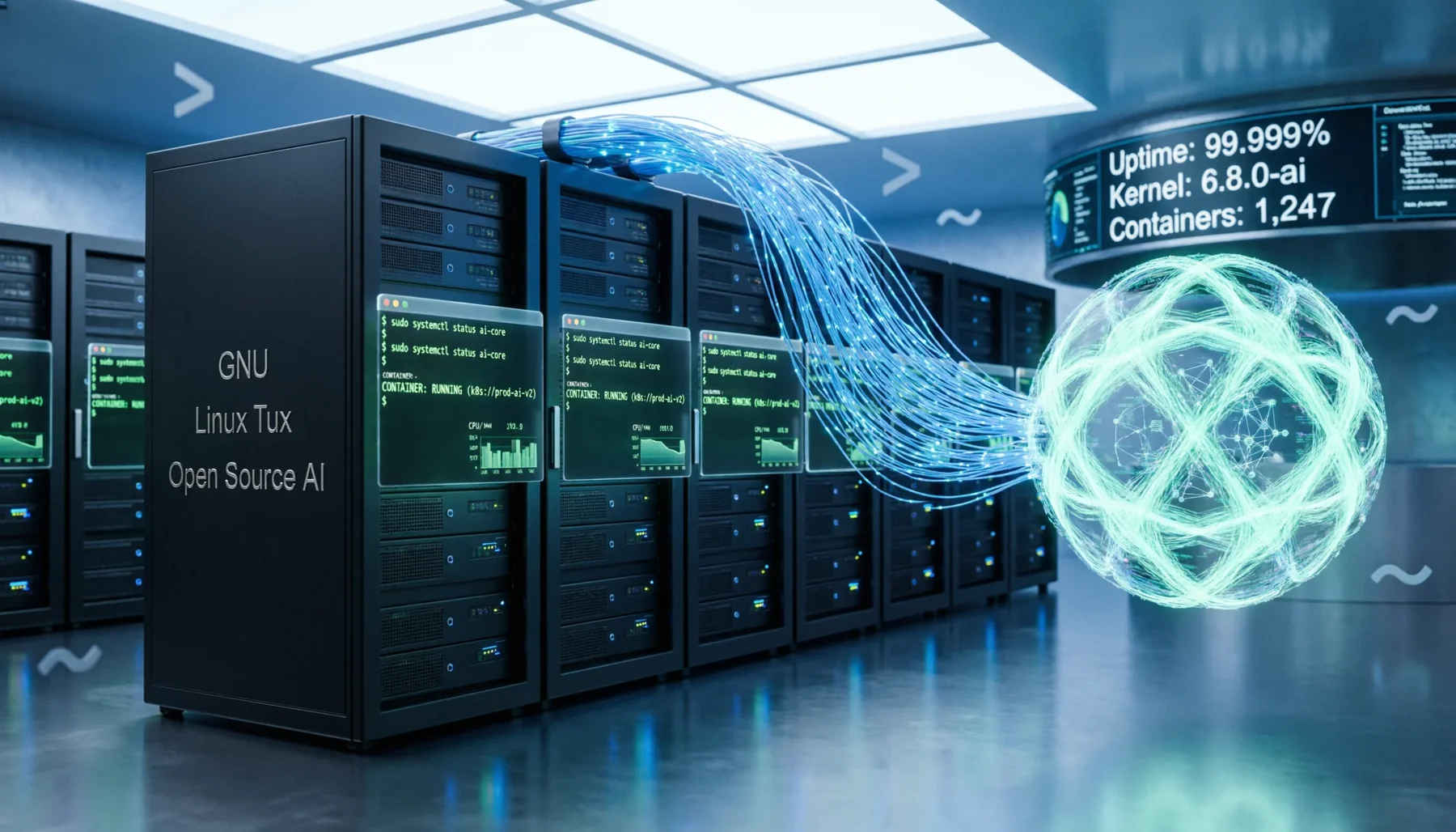
AI 2026:
From Experimentation to Open-Source Industrialization
AI: Industrializing on Open Source
AI is no longer a side project—it is the core engine of our infrastructure. However, this industrialization rests on a fundamental layer that marketing hype often glosses over: the open-source stack. According to Gartner, multi-agent systems rank as the top strategic technology trend for 2026 [1].
"AI Agents" and Multi-Agent Systems
This is the headline topic. We are now deploying autonomous agentsSoftware entities that perceive, decide, and act without ongoing human intervention, orchestrating multiple models to complete complex workflows. that coordinate multiple models in concert. The real challenge lies in governing these agents within our containerized environments. Forrester reports that only 49% of security decision-makers have adopted agentic AI so far, but the momentum is unstoppable [2].
Specialized Models (DSLM) and Open-Weights
To counter the opacity of proprietary models, sovereignty now depends on local, specialized models trained on business-specific data. Open-WeightsModels whose trained parameters (weights) are published openly, enabling local execution without external API dependencies. and commodity NPUsNeural Processing Unit: a specialized processor designed to accelerate neural network operations, bringing AI inference directly to edge hardware. are becoming the standard for hybrid clustersServer fleets combining on-premise resources with public cloud capacity, balancing performance, cost, and data residency requirements.. Both IBM and Gartner recognize DSLMs as a strategic response to cost and compliance pressures [5].
Supercomputer Orchestration
The infrastructure needed to train and run these models demands hybrid architectures (CPU, GPU, neuromorphic) where deep Linux system mastery is non-negotiable. The neuromorphicProcessor architectures inspired by the human brain, using electrical spikes for ultra-energy-efficient computation. computing market is projected to reach nearly $8 billion by the end of 2026 [10].
| Strategic Pillar | 2026 Key Trend | Critical Risk Identified | Open-Source & Linux Answer |
|---|---|---|---|
| 🤖 Multi-Agent Systems | Autonomous agent orchestration (49% decision-makers) | Opacity & proprietary API lock-in | Domain-specific DSLMs & local Open-Weights |
| 🔒 Kernel Cybersecurity | AI-driven 0-day vulnerability hunting in the kernel | Machine-speed memory exploits | eBPF observability + Btrfs/Snapper rollbacks + DoH/ECH |
| ☁️ Cloud Sovereignty | Geopatriation ($80B in sovereign IaaS) | Extraterritorial surveillance & data loss | Confidential Computing (TEE) & local on-prem infrastructure |
| 💻 Software & Vibe Coding | AI-assisted rapid code generation | Exploding silent technical debt & blind spots | SecOps architecture audit & Rust adoption |
Cybersecurity: The Algorithmic War at the Kernel's Core
Cybersecurity is moving from the surface down to the foundations. According to the World Economic Forum, 94% of respondents believe AI will be the primary driver of change in cybersecurity throughout 2026 [11].
AI Auditing the Linux Kernel
We are witnessing an unprecedented arms race where AIs are specifically trained to hunt for vulnerabilities (0-days) and memory corruptions directly inside the Linux kernel source code. If one AI finds the flaw, another is already crafting the exploit. Google has poured $32 billion into an agentic defense portfolio [12].
MLOps Pipeline Security and Data Poisoning
Data PoisoningAn attack that injects corrupted data into a model's training set to alter predictions or implant a backdoor. and the compromise of AI supply chainsThe complete ecosystem of vendors, libraries, pre-trained models, datasets, and tools used to build and deploy AI solutions. A compromise here can introduce vulnerabilities upstream. are the new critical threats. Preventative security is giving way to strict Zero TrustA security model that never trusts by default, requiring continuous verification of identity and permissions for every access request, even internally. architectures.
| Resilience Pillar | Deployed Technology | Immediate Defensive Benefit |
|---|---|---|
| 👁️ Kernel Observability | eBPF (Kernel Sandbox) | Real-time anomaly detection and neutralization inside the OS without kernel source modification. |
| 🔄 Instant Restoration | Btrfs + Snapper (Atomic Snapshots) | Surgical, instantaneous system rollbacks in the event of an exploit, corruption, or intrusion. |
| 🔐 End-to-End Encryption | DoH & ECH (Caddy / Unbound) | Complete cryptographic protection for DNS queries and SNI concealment during TLS handshakes. |
Hardening, eBPF, and Instant Rollbacks
Against machine-speed attacks, perimeter defense is no longer sufficient. Real-time observability via eBPFExtended Berkeley Packet Filter: a Linux kernel technology that runs sandboxed programs in the kernel for observability, security, and networking without modifying kernel source. and filesystem-level resilience have become the new standard. Architectures that leverage BtrfsA Linux filesystem offering atomic snapshots and rollbacks, enabling instant, full-system restoration.—specifically designed for surgical rollbacks via tools like SnapperAn open-source tool that creates and manages Btrfs snapshots, widely used in openSUSE and other distributions for reliable system rollbacks.—are now essential. End-to-end encryption of data streams (DoHDNS over HTTPS: encrypts DNS queries over HTTPS to prevent eavesdropping or manipulation of name resolutions., ECHEncrypted Client Hello: a TLS extension that encrypts the server name during the TLS handshake, shielding the destination domain. via modern proxies like CaddyAn open-source web server and reverse proxy known for effortless configuration, automatic HTTPS (Let's Encrypt), and modern protocol support. or Unbound) is no longer optional.
Cloud & Infrastructure: Sovereignty and "Geopatriation"
The cloud is no longer a mere commodity—it is a territory we must defend and control. Gartner has identified "geopatriation" as one of the major technology trends for 2026 [15].
🏛️ Sovereignty & Geopatriation
Repatriating data and model weights to domestic soil. Shielding operations from extraterritorial surveillance laws and reclaiming direct control over physical hardware.
🔐 Confidential Computing (TEE)
Encrypting AI workloads directly in system RAM during active computation. Hardware isolation ensures zero third-party access, even from cloud hypervisors.
Digital Sovereignty ("Geopatriation")
Beyond the buzzword, this is about the strategic repatriation of critical data and workloads to local infrastructure or sovereign clouds. Global spending on sovereign IaaSInfrastructure as a Service: cloud computing services that provide virtualized resources (servers, storage, networking) on demand, billed by usage. is projected to hit $80 billion in 2026 [16].
Confidential Computing
Processing sensitive data with AI requires encrypting it even while in RAM and during execution. Confidential ComputingA technology using Trusted Execution Environments (TEEs) to isolate data in memory, making it inaccessible even to the OS or hypervisor. has become a mandatory compliance standard, now routinely embedded in major enterprise contracts [18].
Software: The "Vibe Coding" Paradox and Technical Debt
AI-generated code is redefining engineering, but carries a hidden time bomb. According to SitePoint, Vibe CodingA development paradigm where engineers describe intent in natural language and AI produces the code. Humans become architect-auditors rather than line-by-line typists. represents "structured development where the architect examines and refines" [19].
💣 The Vibe Coding Trap
Generating thousands of code lines in seconds creates staggering silent technical debt and introduces unverified security blind spots into production environments.
🦀 The Rust & SecOps Shield
Engineers transition into systems architecture auditors. Adopting Rust guarantees memory safety where legacy C/C++ leaves systems vulnerable to corruption.
The Technical Transformation
| Mutation Axis | Identified Challenge & Risk | 2026 Operational Paradigm |
|---|---|---|
| 💣 Technical Debt & Vibe Coding | Massive unverified code generation creating compounding silent architectural debt and security blind spots. | Zero complacency: every AI-generated code block is rigorously audited, sandboxed, and tested. |
| 👁️ Developer as SecOps Auditor | AI generates syntax at breakneck speed, but humans bear full legal liability in production. | Core engineering mastery shifts from typing code to architectural auditing, security, and strict QA. |
| 🦀 Widespread RustA systems programming language offering compile-time memory safety guarantees without a garbage collector, now adopted by the Linux kernel and critical projects. Adoption | Legacy C/C++ memory corruptions leave systems vulnerable to automated machine-speed exploits. | Enforcing compile-time memory safety across low-level infrastructure and kernel subsystems. |
In Conclusion: 2026 Strategic Synthesis
If there is one takeaway from 2026, it is the end of technological innocence. The forces shaping this year outline an unforgiving computing landscape where architectural mistakes carry immediate consequences:
| Strategic 2026 Dynamic | Operational Ground Reality | SafeITExperts Core Mandate |
|---|---|---|
| ⚡ Industrial AI Factory | Experimentation has yielded to massive, continuous production execution. | Complete command of open-source stacks and sovereign local DSLM deployments. |
| 🛡️ OS-Level Security | Machine-speed kernel 0-day vulnerability arms races. | Geopatriation, eBPF observability, and instant atomic Btrfs rollbacks. |
| 👁️ Developer SecOps Role | AI produces code at scale, but humans shoulder production liability. | Continuous architectural validation, permanent SecOps posture, and Rust adoption. |
AI is the common thread running through every domain. Yet the true competitive advantage of 2026 is not knowing how to prompt a model, but knowing how to secure it, sandbox it, and integrate it into unshakable Linux foundations.
👥 Comments
Comment on this article