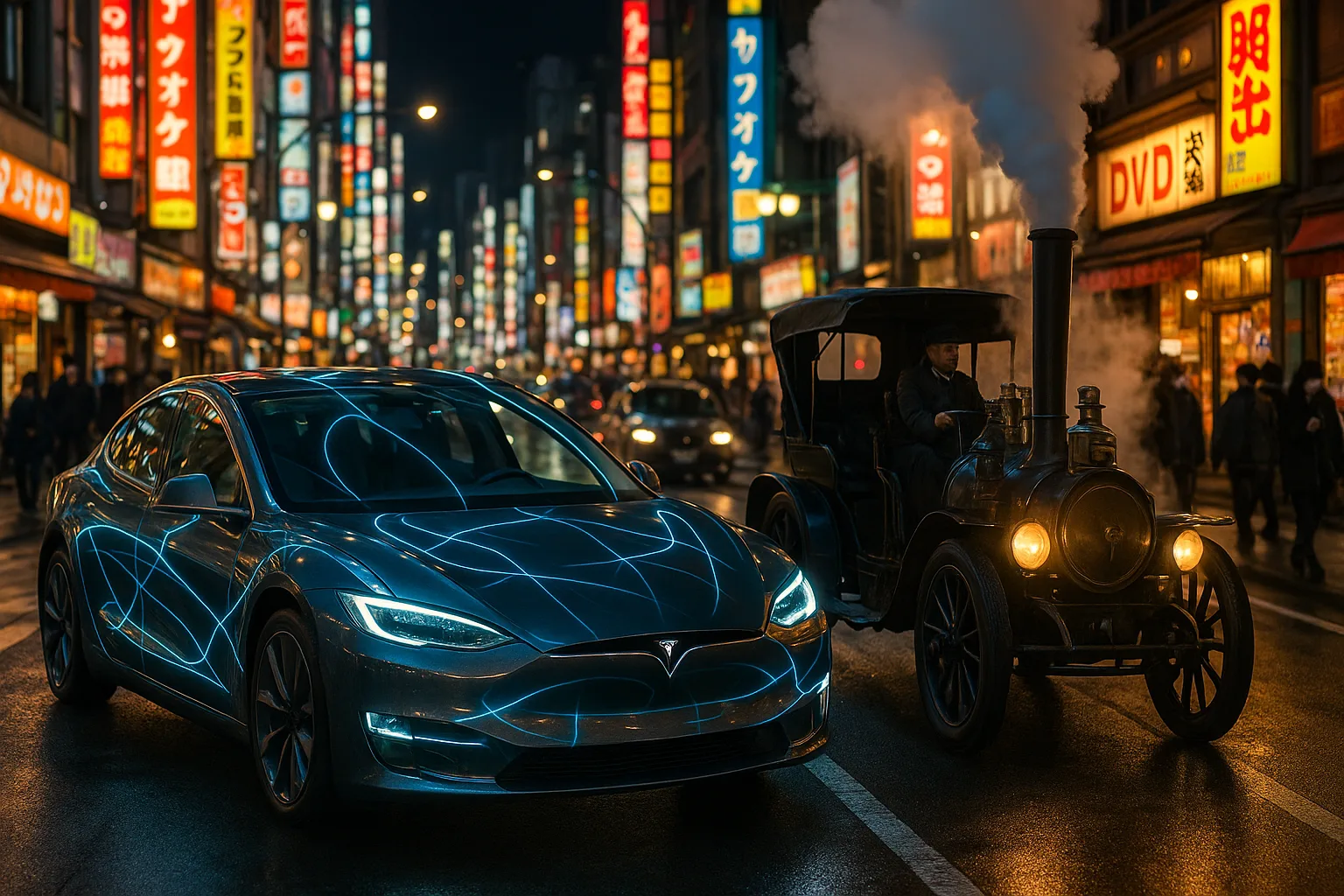
Comprehensive guide to automotive history: from steam carriages to autonomous vehicles, balancing innovation and safety.
Automotive Evolution (1769-2025): Safety, Technology and Sustainable Mobility
Introduction
SafeITExperts has examined the safety level of the automotive industry throughout its evolution. This presentation is the first part of a 3-article series that you will also find in the "HUB" section. Before exploring each era, let us establish the core reality: the automotive industry has never experienced as many structural disruptions as it has since 2020. Mass electrification, the rise of Level 3-4 autonomy, the race toward solid-state batteries, and the strong resurgence of hydrogen are fundamentally redefining mobility, while ridesharing, carsharing, and micromobility are shifting the model from vehicle ownership to mobility usage. Asia, led by BYD, now commands production volumes, Europe is organizing around e-fuels and ISO 21434 compliance, and North America is banking heavily on software architectures and driverless systems. These trends converge toward a single mandate: carbon-neutral, safe, and highly connected mobility by 2035.
Modern Definition: What Is an Automobile Today?
An automobile is a wheeled, motorized vehicle (internal combustion, hybrid, or fully electric) designed for the land transport of passengers and their luggage. In 2025, the automobile integrates advanced connectivity technologies, partial or full autonomous driving capabilities, and sophisticated active and passive safety systems. It sits at the very heart of sustainable mobility challenges, marked by an accelerated global transition toward electrification and hydrogen power.
The Anatomy of an Automobile
Explore the core components of a modern automobile. The overview below outlines major vehicle parts categorized by functional domains. Hover over each term to display its technical specification and function.
💡 Interactive Guide: Hover with your mouse (or tap on mobile) each component below to instantly display its technical description and function.
Lighting
Cabin
Engine
Transmission
Chassis
Safety
Bodywork
Electrical System
Current Landscape: The Permanent Race Between Innovation and Safety
Every technological breakthrough in automotive history has brought along unprecedented safety challenges, forcing manufacturers and regulatory bodies into continuous adaptation. From nineteenth-century boiler explosions to modern automotive cyberattacks, automotive history reveals a persistent rule: innovation always outpaces safety regulation, compelling the industry to issue massive recalls and adopt increasingly stringent standards. Today, cybersecurity has emerged as the central battleground, with ISO 21434 and UN Regulation 155 fundamentally transforming how vehicle safety is engineered.
1. 1769–1895: Steam, Electricity, and Internal Combustion
The dawn of automotive engineering began with Nicolas-Joseph Cugnot's steam dray in 1769, a heavy three-wheeled steam tractor capable of 4 km/h. As early as 1832, Robert Anderson conceptualized an electric carriage powered by primitive non-rechargeable cells. However, Karl Benz's "Patent-Motorwagen" (1886) ultimately established the victory of gasoline propulsion with its 0.75 hp single-cylinder engine achieving 16 km/h.
1.1 Safety Dimensions
1.2 Inventions Fueling the Automobile
Building upon these propulsion breakthroughs, industrial and commercial development expanded rapidly. Automotive pioneers harnessed the Industrial Revolution alongside earlier scientific discoveries:
2. 1908–1939: The Ford Revolution and Democratization
With the moving assembly line perfected in 1913, Henry Ford reduced Model T assembly time from 12 hours 30 minutes down to 93 minutes, driving its retail price below $300 by 1925. Pneumatic tires, electric self-starters, and multi-tier brand segmentation pioneered by General Motors transformed the motor car into an everyday necessity.
2.1 Safety Scandals
The Ford Pinto was a subcompact car whose fuel tank was placed between the rear axle and bumper without structural shielding, causing devastating fires in 30–40 km/h rear-end collisions. An $11 per vehicle baffler fix was engineered but rejected. Development had been compressed from 45 down to 25 months, bypassing critical safety tests.
Ford's economic decision via the notorious "Pinto Memo": estimated recall repair cost of $137 million versus the actuarial value of 180 projected annual deaths at $49.5 million. Lee Iacocca's prevailing motto was: "Safety doesn't sell."
3. 1945–1990: Post-War Boom and Oil Crises
The post-war economic boom saw the birth of icons like the Chevrolet Corvette (1953) and the Citroën 2CV. Early safety standards (mandatory seat belts in 1966; production airbags in 1973) were adopted under intense public pressure following publicized crashes. The 1973 and 1979 oil crises quadrupled crude prices; CAFE regulations enacted in 1975 mandated a 27.5 mpg fleet average, propelling compact powertrains and aerodynamic design.
3.1 Major Scandals
4. 1997–2019: Hybrids and the Electric Renaissance
The Toyota Prius (1997) proved the commercial viability of dual gasoline-electric propulsion with its Hybrid Synergy Drive delivering 500 km range at 4L/100km fuel consumption. But Tesla truly reignited the 100% battery electric vehicle: the Roadster (2008) followed by the Model S (2012) delivered 400 km range and 0–100 km/h acceleration in 3.7 seconds. In parallel, direct injection, electronic engine management, and regenerative braking became standard features.
4.1 Emerging Battery Risks
Mass electrification revealed new hazards tied to high-voltage traction batteries. Thermal runaway can transform a battery pack into a dangerous fire hazard. Lithium-ion cells contain "all the necessary ingredients to sustain a self-propagating fire." Even following firefighter intervention, "re-ignition has been observed up to two days after the initial incident."
5. 2020–2025: Four Major Disruptions
5.1 Autonomy (Levels 0–5)
In 2024, 83% of all new vehicles sold integrated driving assistance systems (Levels 1–2). The first Level 3 type approvals emerged in Germany (Mercedes-Benz Drive Pilot) and Japan (Honda Legend). Tesla aims to deploy highway FSD in Europe subject to definitive adoption of UNECE Regulation 171. Official projections forecast 35% Level 3 and 15% Level 4 vehicles on roads by 2030.
Level 0: No Automation
Level 1: Driver Assistance
Level 2: Partial Automation
Level 3: Conditional Automation
Level 4: High Automation
Level 5: Full Automation
Official projections: 35% Level 3 and 15% Level 4 vehicles by 2030.
In December 2023, Tesla was forced into the largest safety recall in its history (2.03 million vehicles) after 956 crashes investigated by the NHTSA. Issues centered on unintentional Autopilot disengagement and insufficient driver monitoring. Post-recall evaluations indicated drivers could still engage the system even after covering the in-cabin driver monitoring camera.
5.2 Batteries: Chemistry and Performance
LFP batteries exhibit a "lower tendency to catch fire" but generate "hazardous off-gas venting phenomena." Conversely, NMC batteries trigger "more immediate, high-temperature thermal runaway." BYD is already road-testing a Seal prototype claiming up to 1,500 km range (CLTC cycle).
5.3 Hydrogen: Technological Renaissance
The second-generation Toyota Mirai (2021) houses two 5.6 kg carbon-composite tanks at 700 bar alongside a 128 kW PEM fuel cell, reaching 0–100 km/h in 9 seconds. The Hyundai Nexo and BMW iX5 complete the offering, supported by EU financing for 120 additional hydrogen stations by 2027.
Hydrogen stored at 700 bar presents unique safety characteristics. Colorless, odorless leaks can create explosive atmospheric mixtures over a wide range. High-pressure composite tanks require ultra-resistant materials and sophisticated ventilation to prevent gas buildup in enclosed spaces. Multiple fueling station incidents have been recorded in Norway and California.
5.4 Shared Mobility and Micromobility
Urban mobility frameworks increasingly combine dedicated carpooling highway lanes with sustainable commuter subsidies. Electric stand-up scooters remain permitted from age 14 with speed limits strictly regulated at 20–25 km/h.
Electric micromobility introduces novel safety concerns. Battery fires involving electric scooters have surged: an incident in Reims in June 2025 resulted in 4 deaths during overnight charging. Major cities including New York have enacted strict regulations and restrictions on indoor lithium battery charging.
5.5 Cybersecurity and In-Vehicle AI
The proliferation of 5G cellular connections and OTA firmware updates exposes modern vehicles to unprecedented cyber threats. Automakers are establishing dedicated VSOC centers and onboard IDS, while generative AI already optimizes real-time anomaly detection.
In July 2025, the "PerfektBlue" Bluetooth vulnerability affecting Mercedes and Volkswagen demonstrated the imperative of ISO/SAE 21434-compliant CSMS. Connected vehicles face three primary attack vectors: personal data theft (38% of automotive cyberattacks), remote takeover (20%), and denial-of-service attacks. The European Union mandates a Cyber Security Management System for all new vehicles under UN Regulation 155.
5.6 Takata Airbags: An Unprecedented Defect
The Takata crisis represents the largest safety recall in automotive history, involving over 50 million vehicles globally. The core defect was using ammonium nitrate as an airbag inflator propellant: this volatile chemical degraded under ambient heat and humidity, causing violent explosions that sprayed metal canister shards into vehicle cabins. The global human toll is devastating: at least 28 deaths in the United States and 16 in France, predominantly in tropical territories where high humidity accelerated degradation.
6. The New Geopolitics of Electric Mobility
Global 2024 sales placed BYD at the worldwide summit with 4.25 million EVs, surpassing Tesla (1.8 million). Volkswagen, Stellantis, and Chinese innovators NIO, XPeng, and Li Auto completed the Top 8. Blade LFP battery technology and full vertical integration provide BYD with a 22% gross margin.
6.1 Strategic Security Dimensions
7. Advanced Biofuels and Synthetic E-Fuels
For sectors that are difficult to electrify directly, the European RED III directive sets a target of 5.5% advanced biofuels by 2030, capping first-generation crop-based fuels at 7%. HVO derived from waste cooking oils cuts lifecycle CO₂ emissions by 90% compared to fossil diesel. In e-fuels, European initiatives are funding commercial-scale electrolysis facilities totaling 1 GW to produce 75,000 tons/year of e-SAF by 2030.
7.1 Industrial Safety
8. Environmental Impact and Challenges
Historical CO₂ Emissions
Since 1900, the automotive sector has emitted over 1,200 gigatons of CO₂. Despite technological improvements, transport still accounts for 24% of global greenhouse emissions in 2025.
Battery Recycling
Only 5% of lithium-ion batteries are currently recycled in Europe. European regulations mandate a 65% recycling rate by 2030. Advanced recyclers like Northvolt achieve recovery rates of up to 95% for battery-grade metals.
Lithium Extraction
Extracting one ton of lithium requires up to 2 million liters of water, causing local water depletion. Salar brine extraction operations in Chile consume up to 65% of regional water resources in the Atacama basin.
9. Heading Toward 2030–2040: Trends and Challenges
9.1 Safety Challenges of Artificial Intelligence
Europe is finalizing the automotive AI Act, while China is deploying proprietary national benchmarks, creating risks of global regulatory fragmentation. Solid-state battery architectures will also introduce unique thermal management challenges during ultra-fast charging (>400 kW).
9.2 Technological Timeline
Automotive Glossary
Essential terminology to understand automotive technology and safety evolution
Automotive Safety Quiz
Test your knowledge on technological and safety milestones
You have completed the quiz!
Conclusion: Innovation in the Crucible of Safety
Over 250 years, the automobile transformed from an unpredictable steam tractor into an intricate cyber-physical edge computing platform. Each technological leap created unforeseen safety imperatives. History demonstrates an inescapable reality: innovation consistently outpaces safety engineering.
Today, automotive engineers, policymakers, and consumers possess the foundational technologies required to solve these challenges. ISO 21434 and UN R155 establish binding cybersecurity baselines, stable LFP chemistries mitigate thermal runaway, and predictive AI enhances fault detection before mechanical failures occur.
- NHTSA Recalls — Official Vehicle Safety Recalls
- UNECE Transport — UN R155 & R156 Cybersecurity
- IEA Outlook — Global Electric Vehicle Outlook
- Battery 2030+ — European Battery Research Initiative
- US DOE AFDC — Alternative Fuels & E-Fuels
- SAE International — ISO/SAE 21434 Vehicle Standard
- Reuters — Automotive & Transportation News
- BloombergNEF — Electric Transport & Battery Market
- MIT Tech Review — AI & Autonomous Systems
- Hydrogen Council — Hydrogen Energy Deployment
- Nature Energy — Advanced Solid-State Battery Research
- IEEE Spectrum — Automotive Sensors & Autonomy
- EEA Transport — European Transport Emissions Data
- Waymo Safety — Autonomous Driving Safety Benchmarks
Safe travels and drive safely! 🚗🔒
👥 Comments
Comment on this article