🏥 Cybersecurity in Hospital Environments:
A Vital Imperative Against the Invisible Threat
The healthcare sector has become the prime target for cybercriminals. Discover why and how to build robust defenses.
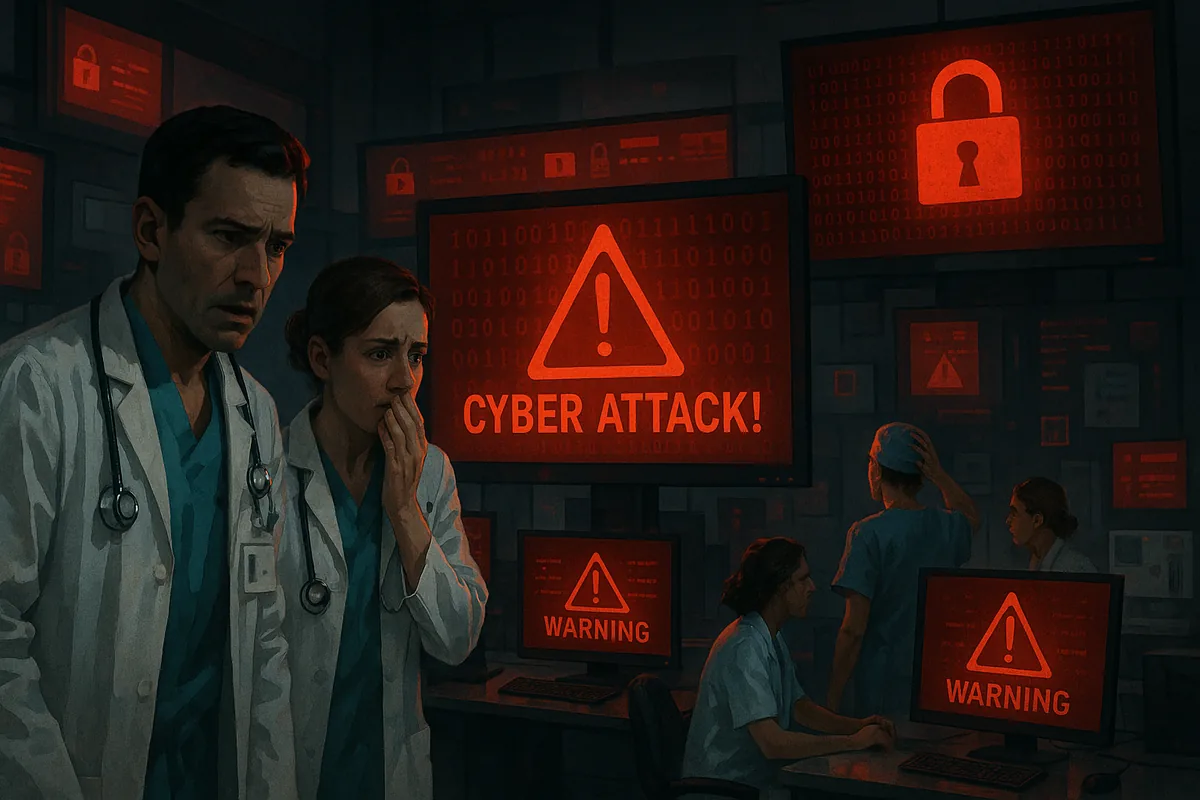
Introduction: A Strained Ecosystem Under Attack
The healthcare sector has become the prime target for cybercriminals, with a 32% surge in global cyberattacks in 2024. National cybersecurity agencies (including France's ANSSI and US CISA) documented over 400 major attacks against healthcare institutions, ranking the medical sector as the third most affected worldwide, directly behind local municipal governments and small-to-medium enterprises [1].
Increase in Attacks in 2024
+32%
Value of Medical Records
€350 / record
Case Studies: When Digital Paralysis Disrupts Patient Care
The CHSF Medical Center Attack (2022)
- Ransom demand: $10 million
- Impact: Emergency transfer of neonatal infants, total disruption of automated laboratory analyzers, and the exfiltration of 11 GB of highly sensitive patient and medical staff data
- Total remediation cost: €7 million, including comprehensive network and IT architecture reconstruction
The Dax Hospital Incident (2021)
A debilitating ransomware outbreak paralyzed the medical facility for several weeks, leading to massive surgical cancellations and a 20% drop in overall medical activity [3].
The Düsseldorf University Hospital Case (2020)
Widely cited as the first patient fatality directly associated with a ransomware disruption: an emergency patient requiring urgent critical care could not be admitted in time following complete clinical systems lockup [4].
Why Are Hospitals Prime Targets?
Structural Factors
- Highly sensitive data: Comprehensive Electronic Health Records (EHR), social security numbers, clinical prescriptions, and billing identities
- Heterogeneous systems: Up to 1,000 distinct software applications within a single university hospital center, exponentially multiplying attack surfaces and entry points
- Chronic underinvestment: Historically only 1.7% of healthcare IT budgets dedicated to cybersecurity, compared to over 9% in the banking and finance sector
Human Factors
- 70% of successful breaches originate from human error: compromised credentials, unmanaged USB media, and targeted phishing lures [6]
Protection Strategies: The National Action Plan
The CaRE Program (Cyber-Acceleration and Resilience in Healthcare)
- Budget: €750 million over 5 years (2023–2027) dedicated to modernizing and securing hospital digital infrastructures
- Concrete results:
- -20% decrease in critical directory vulnerabilities across Active Directory deployments
- -35% reduction in high-risk Internet exposure
Cyber Hygiene: 4 Core Pillars
- Continuous training: Practical workshops for clinical staff, structured cyber hygiene toolkits and awareness campaigns
- Shared security culture: Regular, contextualized simulation drills (including simulated spear-phishing campaigns)
- Technical infrastructure hardening: Systematic patching of core systems (operating systems, network switches) and strict segmentation of remote VPN access
- Zero Trust Architecture: Rigorous continuous authentication and least-privilege verification across both perimeter and internal networks [8]
Vulnerability Management: A Continuous Lifecycle
- Phase 1: Comprehensive asset discovery and inventory (IoMT endpoints, telemetry sensors, database servers)
- Phase 2: Risk prioritization and clinical impact assessment (e.g., connected CT scanners and dialysis units)
- Phase 3: Prioritized patch deployment and mitigations (e.g., firmware updates for pacemakers and telemetry devices)
| Metric | Before CaRE | After CaRE | Improvement |
|---|---|---|---|
| Critical vulnerabilities | 42% | 22% | -20% |
| Public Internet exposure | 68% | 33% | -35% |
| Staff security training | 18% | 65% | +47% |
Actionable Recommendations for Healthcare Facilities
- Annual cyber crisis simulation exercises: Mandatory annual operational drills testing response readiness and clinical continuity
- Immutable offline backups: Air-gapped and write-once backup repositories to defeat ransomware encryption mechanisms
- Regional hospital group convergence: Pooling cybersecurity talent, SOC capabilities, and resources across regional healthcare groups (GHT / trusts)
- Curriculum integration in healthcare education: Mandatory digital security and hygiene modules for healthcare professionals and medical students
Conclusion: Toward Collective Healthcare Resilience
Hospital cybersecurity is no longer merely an IT operational challenge; it is an uncompromising public health imperative. Under the European NIS 2 Directive and international regulatory frameworks, healthcare institutions must meet rigorous, standardized cybersecurity baselines by 2026 [9].
"Investing in cybersecurity is fundamentally investing in patient safety and quality of care. A clinical system crippled by ransomware does not just endanger confidential records: it jeopardizes human lives."
The strategic objective? Evolving healthcare establishments from vulnerable soft targets into resilient digital fortresses, engineered to guarantee uninterrupted continuity of care even in the midst of active cyber incidents.
Sources & Bibliography
- [ANSSI] Cyberthreat Overview & Healthcare Sector Analysis
- [Ministry of Health] CaRE Program (Cyber-Acceleration and Resilience in Healthcare)
- [Court of Accounts / Audit Office] Special Report on Healthcare IT Security and Resilience 📄 PDF
- [Digital Health Agency] Healthcare Cyber Hygiene Guidelines - Phase 1 Implementation 📄 PDF
Technical Glossary
| Term | Definition |
|---|---|
| Ransomware | Malicious software that encrypts vital system data and demands a ransom payment in exchange for decryption keys |
| NIS 2 | European Union directive establishing heightened cybersecurity standards across essential critical infrastructure sectors, including healthcare |
| Zero Trust Model | A security paradigm operating on the principle of 'never trust, always verify', enforcing strict identity validation for every user and device |
| GHT / Hospital Consortia | Territorial hospital groups pooling medical IT resources, cybersecurity infrastructure, and administrative functions |
👥 Comments
Comment on this article